-
It Had to Happen

An ad Val and I mocked up for the Chompers & Stompers 2005 Program (that’s a family reunion-type thingy for those who I haven’t shared the C&S; story with yet… one of the seventy-squintillion things I need to get around to posting about on this here blog, one of these days…)
Ahem. Anyway, yeah. Sibling. W00t!
-
Let It Go, Guys
As if Ohio State tight end Ryan Hamby didn’t feel bad enough about dropping a touchdown pass during Saturday’s 25-22 loss to Texas.
According to a report in the Akron Beacon Journal, the fifth-year senior has received “a couple hate” e-mails from irate fans.
…The play that apparently inspired the offensive e-mails came with about six minutes remaining in the third quarter. Hamby bobbled an 8-yard pass from Justin Zwick in the end zone that would have given the Buckeyes (assuming the extra point was good) a 26-16 lead. Instead, Ohio State had to settle for a field goal and a 22-16 advantage.
[more]
I mean, yeah, we’re all bummed about losing to No.2 Texas, but come on.
-
Nine Billion Names
Via boingboing, here is a very, very quick scifi short story that — well, the phrase “High Concept” doesn’t really do it justice, but it’s pretty damn close. And the piece is AWESOME.
Part of the 365 Tomorrows project, which will apparently be putting shorts like these online, a day at a time, for an entire year.
-
Living in the Future

Self-heating coffee. Self-heating coffee that tastes good.
Seriously. This is at once the most ridiculous thing ever produced by Starbuck-driven America (come on, who needs self-heating coffee when there’s a freaking coffee shop on virtually every corner?) and the most genius idea I’ve ever seen. Basically, you turn the can over and push this little button on the bottom that drops some mineral/chemical into the water surrounding the inner can. Wait five seconds, turn the can back over, and wait for another two or three minutes while the mineral and the water react and heat up — thus, heating the coffee in the inner can. Shake, pop the top, and you’ve got hot coffee.
Val says the vanilla latte is better than this one (it’s the mocha latte), but who knows? It’s coffee from the future.
-
Katrina, Anger
I still don’t know how to even address what’s going on in NOLA, and frankly, my viewpoint means about thismuch when it comes to the relief efforts currently going on. Anger would be a good word, if what I was feeling didn’t pale in comparison to what displaced families must be experiencing more than week after they’ve lost EVERYTHING, for what is definitely looking like no good reason.
So, here: here are some things you should read.
- Keith Olbermann on MSNBC: “No one is suggesting that mayors or governors in the afflicted areas, nor the federal government, should be able to stop hurricanes. Lord knows, no one is suggesting that we should ever prioritize levee improvement for a below-sea-level city, ahead of $454 million worth of trophy bridges for the politicians of Alaska.
“But, nationally, these are leaders who won re-election last year largely by portraying their opponents as incapable of keeping the country safe. These are leaders who regularly pressure the news media in this country to report the reopening of a school or a power station in Iraq, and defies its citizens not to stand up and cheer. Yet they couldn’t even keep one school or power station from being devastated by infrastructure collapse in New Orleans — even though the government had heard all the “chatter” from the scientists and city planners and hurricane centers and some group whose purposes the government couldn’t quite discern… a group called The U.S. Army Corps of Engineers.
“And most chillingly of all, this is the Law and Order and Terror government. It promised protection — or at least amelioration — against all threats: conventional, radiological, or biological.
It has just proved that it cannot save its citizens from a biological weapon called standing water.”
- CNN compares statements by FEMA and DHS personnel last week to on-the-ground news reports. The total and absolute disconnect between them is disturbing at best.
- Leaked memo from FEMA head to DHS head, sent on Monday (at least after the storm came through on Sunday night) purportedly shows request for help within 48 hours (so, that’d be by Wednesday) and indicates that at least one of the duties of all FEMA personnel attached will be to “convey a positive image of disaster operations to government officials, community organizations and the general public.“
- Salt Lake Tribune, yesterday: “As New Orleans Mayor Ray Nagin pleaded on national television for firefighters – his own are exhausted after working around the clock for a week – a battalion of highly trained men and women sat idle Sunday in a muggy Sheraton Hotel conference room in Atlanta.
“Many of the firefighters, assembled from Utah and throughout the United States by the Federal Emergency Management Agency, thought they were going to be deployed as emergency workers.
“Instead, they have learned they are going to be community-relations officers for FEMA, shuffled throughout the Gulf Coast region to disseminate fliers and a phone number: 1-800-621-FEMA.
“On Monday, some firefighters stuck in the staging area at the Sheraton peeled off their FEMA-issued shirts and stuffed them in backpacks, saying they refuse to represent the federal agency.
“Federal officials are unapologetic.
“‘I would go back and ask the firefighter to revisit his commitment to FEMA, to firefighting and to the citizens of this country,’ said FEMA spokeswoman Mary Hudak.
“The firefighters – or at least the fire chiefs who assigned them to come to Atlanta – knew what the assignment would be, Hudak said.
“‘The initial call to action very specifically says we’re looking for two-person fire teams to do community relations,’ she said. ‘So if there is a breakdown [in communication], it was likely in their own departments.’”
- The President on GMA, 9/1/05: “”I don’t think anybody anticipated the breach of the levees. They did anticipate a serious storm. But these levees got breached.” Possible, one supposes, that he hadn’t seen any of the eight news stories printed or broadcast in the last five years about the potential danger to NOLA from a hurricane, or read any of the FEMA, Army Corps of Engineers, or Louisiana State University studies or computer models indicating what might happen. But it’s pretty damned hard to say he wasn’t directly warned before the storm made landfall. [Froomkin himself addresses the issue in that same WaPo piece from 9/1, here.]
I’m sure I could do more, but that’s about all I can stomach right now.
- Keith Olbermann on MSNBC: “No one is suggesting that mayors or governors in the afflicted areas, nor the federal government, should be able to stop hurricanes. Lord knows, no one is suggesting that we should ever prioritize levee improvement for a below-sea-level city, ahead of $454 million worth of trophy bridges for the politicians of Alaska.
-
Abandon Ship
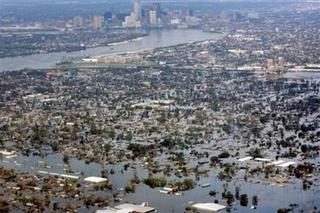
The governor of Louisiana says everyone needs to leave New Orleans due to flooding from Hurricane Katrina. “We’ve sent buses in. We will be either loading them by boat, helicopter, anything that is necessary,” Gov. Kathleen Blanco said. Army engineers struggled without success to plug New Orleans’ breached levees with sandbags, and Blanco said Wednesday the situation was worsening, leaving no choice but to evacuate.“The challenge is an engineering nightmare,” Blanco said on ABC’s “Good Morning America.” “The National Guard has been dropping sandbags into it, but it’s like dropping it into a black hole.”
As the waters continued to rise in New Orleans, four Navy ships raced toward the Gulf Coast with drinking water and other emergency supplies, and Red Cross workers from across the country converged on the devastated region. The Red Cross reported it had about 40,000 people in 200 shelters across the area in one of the biggest urban disasters the nation has ever seen.
The death toll from Hurricane Katrina reached at least 110 in Mississippi alone, while Louisiana put aside the counting of the dead to concentrate on rescuing the living, many of whom were still trapped on rooftops and in attics.
A full day after the city thought it had escaped Katrina’s full fury, two levees broke and spilled water into the streets of New Orleans on Tuesday, swamping an estimated 80 percent of the bowl-shaped, below-sea-level city, inundating miles and miles of homes and rendering much of New Orleans uninhabitable for weeks or months.
“We are looking at 12 to 16 weeks before people can come in,” New Orleans Mayor Ray Nagin said on ABC’s “Good Morning America, “and the other issue that’s concerning me is have dead bodies in the water. At some point in time the dead bodies are going to start to create a serious disease issue.”
[more]
… 12 to 16 weeks? That’s three to four months.
Help: links to the Network for Good hurricane relief efforts and the Red Cross’s Disaster Relief Fund donation site.